|
Customer case · Cattle barn
They did not change the feed. They did not change the herd.
They changed the lighting — and gained 848 kg more milk per cow
It may sound too good to be true: one single change in the barn, and milk yield increases significantly without adding a single new cow. But that is exactly what happened in a Danish herd of 213 cows after the lighting control was set up in a completely new way. Here is the story of what they did — and why it worked.
|
The starting point: lighting that was simply there
As in many cattle barns, the lighting in this herd was not something that received much attention. The lights were switched on in the morning and off in the evening — with no fixed schedule, no adjustment for the season, and no consideration of the fact that different areas of the barn actually have different lighting needs.
This is not unusual. Most farmers have full control of feed, water and ventilation, but lighting is often overlooked — even though cows’ hormonal systems and milk production are directly influenced by light and darkness, much like our own circadian rhythm.
|

|
The solution: lighting with a purpose
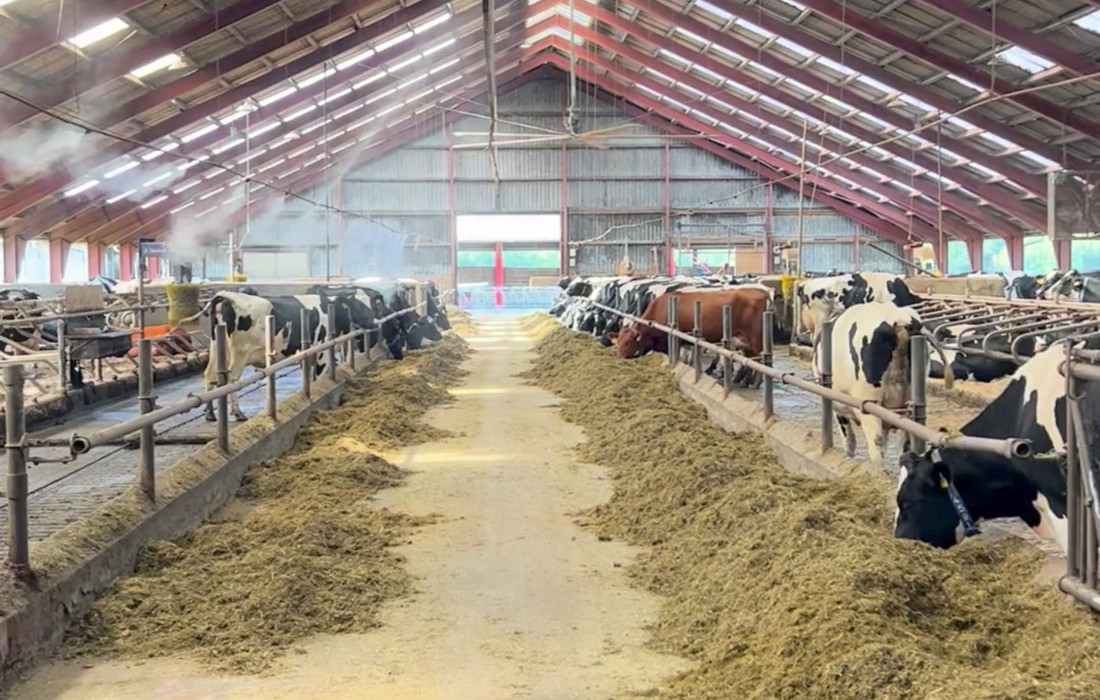
In collaboration with RN Solutions, the herd had LED lighting installed together with EasySmartFarm lighting control. Instead of having one lighting setup switched on or off throughout the entire barn, the lighting was divided into zones and programmed according to what each area was actually used for.
The cow barn received 200 lux for 16 hours a day — the level that supports a stable hormonal balance and thereby milk yield. Dimming and 0–10 V control made it possible to simulate a natural lighting rhythm, with smoother transitions in the morning and evening instead of lighting that simply switches on and off at the press of a button.
|
|
|
|
848 kg
More milk
per cow/year
|
|
|
|
Why does lighting actually affect milk yield?
Cows respond to light and darkness like many other mammals. Longer periods of light — known as Long Day Lighting — affect the hormone melatonin, which in turn is linked to the production of the growth factor IGF-1. This is one of the reasons why correct lighting can support higher milk yield without changing feed or breeding.
However, this requires the lighting to actually be correct: enough lux, for a sufficient period of time, and without too many interruptions to the lighting rhythm. This is where many barns — knowingly or unknowingly — fall short.
|
|
"When we spoke in September 2024, we did not have the final figures yet — but we could already notice a positive difference, especially in reproduction. After installing RN Solutions' Stealth Spandelampe and automated lighting control at Junge Gård in Aulum, we can now see it in the results: in one year, we have increased milk production per cow (ECM) by 6.8%. The light environment has improved significantly, there's more calm in the barn, and it has also lifted the working environment."
— Lars Remme Larsen, Junge Gård, Aulum
|
|
Not an isolated case
The same pattern is seen among several of our customers. At Anders Just’s farm in Snedsted, milk yield increased by 768 kg per cow/year after the same type of solution — an increase of 6.2%, with a payback period of just 0.25–0.33 years. In Niels Peter Utoft Nielsen’s herd of 241 cows, the result was an increase of 5.9%, corresponding to 737 kg per cow per year.
The figures vary from barn to barn, but the direction is the same: when lighting becomes an active part of the operation instead of an afterthought, the results follow.
|
|
Could your barn have the same potential?
Get a free lighting calculation tailored to your barn
We assess your barn layout and current lighting and give you a specific recommendation for what correct lighting could mean for your operation — completely free of obligation.
Read more about cattle and dairy barn lighting
|
|
|
The results are based on specific customer cases and may vary from barn to barn. The effect depends on the barn design, existing light level, installation and the daily lighting programme.
|

 Dansk
Dansk
 Deutsch
 Español
 Svenska
 Polski
 Українська