Dansk
Dansk
 Deutsch
 Español
 Svenska
 Polski
 Українська

Poultry Rearing: How to Ensure Calm, Growth, and Efficiency with Proper Lighting Control
- 03 Oct, 2025
- News and Press Coverage , Blog
All we need is:
- Your contact details
- A short description of your enquiry
- We will get back to you as soon as possible
Contact us for a free, personal and non-binding consultation
Correct lighting during the rearing period is one of the most important tools for giving chicks a strong start, supporting uniform growth and reducing the risk of early mortality.
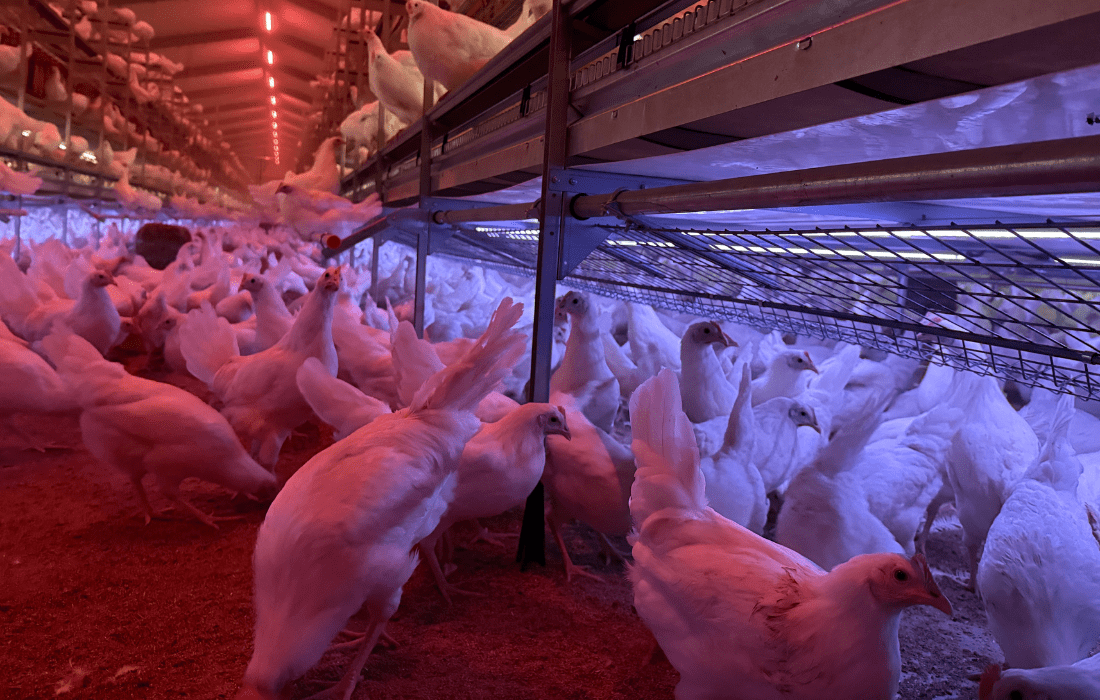
Contact usIn the first weeks of a bird’s life, the foundation is laid for a stable and productive flock. During this period, lighting plays a key role. Not only to ensure that the chicks find feed and water, but just as importantly to create a sense of security, regulate behaviour and support growth.
At RN Solutions, we work with LED lighting and light control tailored to the biology and behaviour of poultry. This makes it possible to adapt the lighting environment precisely throughout the entire rearing period – and thereby prevent many of the typical challenges producers face.
A bright and uniform start from day one
From the very first day in the house, the light must be clear and evenly distributed so the chicks can quickly orient themselves. During the first week of life, a light level between 20 and 50 lux is recommended.
This may sound modest, but it is precisely enough for the birds to easily find their way to feed and water. That is essential for a good start and low mortality.
We help you set the correct light level and light curve from the first day through the full rearing period.
Reduce the light level from week two
Already from week two, the light level should be reduced to somewhere between 5 and 20 lux. Lower lighting creates calmer behaviour, less unrest and fewer escape attempts.
This helps create a stable and harmonious flock, which has a direct impact on both growth and feed conversion. This is where dimmable luminaires show their strength: With gradual adjustment, you can adapt the light to the birds’ age and behaviour without changing equipment.
Lower light, calmer behaviour
A controlled reduction in light level can help reduce unrest and support a more stable flock structure.
Dimmable luminaires
Gradual dimming makes it possible to follow the birds’ development without replacing or moving the lighting installation.
Better growth conditions
A stable lighting environment supports feed intake, growth and a more uniform flock during the rearing phase.
Colour spectrum and rhythm matter
Light intensity is not the only important factor. The colour spectrum and the rhythm of the light also play an important role. In rearing, we typically use cool white light, which supports activity and growth without overstimulating the birds.
Just as in nature, it is important to have a rhythm that clearly separates day and night. Birds exposed to constant or irregular light risk disruption of their biological clock, which can affect growth, immune function and later production capacity.
Cool white light
Supports activity and growth during rearing without creating unnecessary overstimulation.
Clear day and night rhythm
A stable rhythm helps protect the birds’ biological clock and supports natural behaviour.
Prepared for later production
A controlled rearing period creates a stronger basis for the later laying phase and overall production performance.
Measure the light as the birds experience it
Another factor that is often overlooked is how poultry actually perceive light. Birds have a completely different visual perception than humans. They do not just see more sharply – they also perceive a broader part of the colour spectrum, including ultraviolet light.
Therefore, it is not sufficient to measure light only in ordinary lux, which is based on human visual perception. Instead, clux – chicken lux – should be used, as it takes into account how the light is experienced by the birds.
By adjusting the lighting based on clux level, you gain more precise control of the biological effect the light has on the birds. This means that lower light levels can often be used without compromising effect – and at the same time energy consumption can be reduced.
Flicker Free lighting and intelligent control
The combination of dimmable, Flicker Free luminaires and clux-optimised lighting design makes it possible to tailor a solution that promotes welfare while minimising wasted energy.
With intelligent light control such as RNS Digital Light Control 0–10V, you can plan the entire light curve in advance so it follows the chicks’ needs day by day – without manual adjustment.
RN Solutions · Rearing lighting
Designed for the first weeks.
Built for the full production cycle.
Our rearing lighting solutions combine dimmable LED luminaires, Flicker Free technology, clux-optimised design and intelligent 0–10V light control.
Contact us about rearing lighting
A strong start pays off later
The rearing period is a vulnerable but decisive phase in poultry production. A well-adapted lighting environment helps ensure a smooth start, fewer problems and a strong foundation for the later laying phase.
This is where investment in correct lighting truly pays off.
Do you want to optimise your rearing with professional light control and energy-efficient solutions? Contact RN Solutions – we help you find the optimal lighting for your specific poultry house.
RN Solutions · Rearing lighting
Do you want a stronger start
for your flock?
We prepare a lighting solution adapted to the rearing period – with the right lux level, clux focus, dimming and intelligent control.