Dansk
Dansk
 Deutsch
 Español
 Svenska
 Polski
 Українська

The light in the barn costs more than you think – and delivers more than you expect.
- 17 Jun, 2026
- News and Press Coverage , Blog
We just need:
- The dimensions of your buildings and spaces
- Information about the purpose and production type in each space
- Your preferred lux level
Contact us for a free, personalised and no-obligation calculation:
More and more farmers are replacing their lighting – not because it has broken down, but because they have done the maths on what it costs to leave it as it is.
Contact usSince the energy crisis left its mark on operating budgets, many dairy producers have been scrutinising their fixed costs. Feed, diesel and machinery have received the most attention – but one area remains consistently underestimated: lighting.
That is a paradox, because lighting in a modern dairy barn is not just an operating cost. It is a production tool.
Lighting affects milk yield – the evidence is clear
Research from Cornell University and Aarhus University, among others, consistently points in the same direction: cattle exposed to controlled Long Day Lighting (LDL) at a minimum of 150–200 lux for 16–18 hours per day produce significantly more milk than animals kept under irregular or insufficient light.
The mechanism is well documented: light suppresses melatonin production, which in turn stimulates IGF-1 (Insulin-like Growth Factor 1), directly linked to milk production. This means a barn with incorrectly positioned lights, insufficient lux levels or uneven distribution is not just saving energy – it is losing production.
The problem is not only the fixtures. It is also the placement.
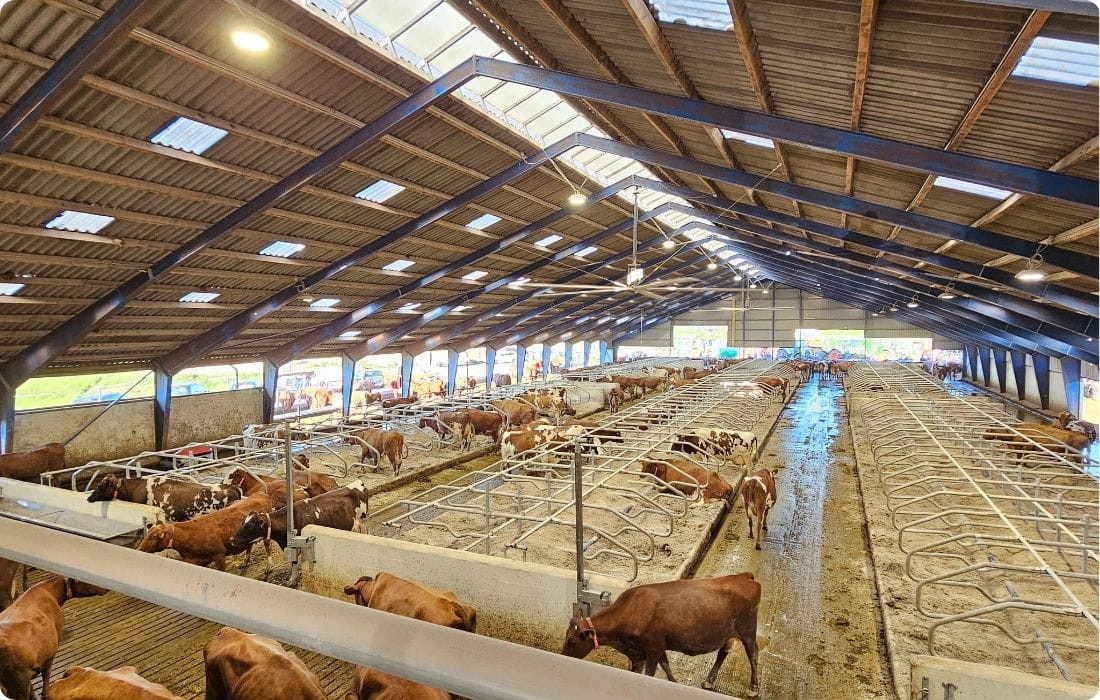
The most common issue we at RN Solutions encounter when visiting a cattle barn for the first time is that there is often too little light in the barn – and at the same time, the lighting is positioned incorrectly.
High-mounted fixtures with wide beam angles create large dark zones at the feed table and in the cubicles. Animals move towards the light, and behaviour changes in ways that are rarely linked back to the lighting. Feed intake, movement patterns and herd calm are all influenced by light distribution. A barn can have enough fixtures to satisfy an eye looking upward – and still have critical zones, where the animals spend most of their time, that never reach the required lux level.
The second most common problem is simply too little light overall. Many barns were built or renovated with lighting dimensioned for working light – not production light. The difference between 80 lux and 200 lux is not visible to the human eye during normal operations, but it shows up in the milk tank.
Both problems are only identified through a precise lighting calculation. We carry out lighting calculations for each individual barn before installation – a review of barn dimensions, construction, reflectance values and production type, resulting in a specific plan for fixture type, quantity and mounting height. Not a standard quote. A calculation.
Most people only discover the problem when we carry out a lighting calculation. Contact us and we will review your barn.
Light control: the third parameter that is often overlooked
Correct placement and sufficient lux levels are the foundation. But in modern dairy production, light control is what ties everything together. The ability to programme light periods, adjust intensity throughout the day and tailor lighting scenarios for different zones in the barn – milking area, cubicles, feed table – gives the farmer an active production tool rather than a fixed installation.
This is where many standard solutions fall short. A fixture can be technically sound and correctly positioned, yet still deliver a flat, undifferentiated light that fails to realise the potential the research points to. Light control is not an optional extra – it is part of the calculation.
TCO: what you pay over time is what matters
A LED fixture designed for barn environments costs more than a conventional solution at the point of purchase. That is undeniable. But the calculation looks different when you consider Total Cost of Ownership over 8–10 years.
A fixture that lasts, requires no bulb replacements, withstands high-pressure cleaning (IP69K), can be mounted precisely and delivers the correct lux level from day one – that fixture is cheaper than one that looks similar but was not designed for barn environments.
The challenge is that many farmers have experienced exactly that: fixtures marketed for barn use that fail to cope with daily cleaning, begin to malfunction within two to three years, and when the light fails, production follows.
What separates good barn lighting from the rest?
There are three parameters that determine whether a lighting solution actually delivers what it promises in a dairy barn:
Genuine IP rating
IP69K is the standard for environments with high-pressure cleaning, ammonia and moisture. It is not enough for a fixture to be "waterproof" – it must be tested and certified for the specific barn environment.
LM80/TM21-documented lumen depreciation
Light output decreases over time in all LED solutions. LM80 test data shows how much – and the TM21 calculation predicts lumen output after 50,000 operating hours. Without that documentation, there is no way of knowing whether the light will still deliver the calculated lux level five years down the line.
Lighting calculation as a prerequisite – not an afterthought
A barn is not a warehouse. Construction, reflectance, herd size and production type all determine what is required. Without a calculation in hand before installation, there is no real way of knowing whether the installation delivers what was promised – at commissioning or five years later.
The quiet revolution continues
At RN Solutions we see the same pattern repeat itself: farmers who have done the maths, spoken to an adviser or visited a neighbour with new lighting – and who afterwards cannot understand why they waited so long.
RN Solutions · SPEED-LIGHT series
Built for barn environments.
Not adapted to them.
SPEED-LIGHT is developed specifically for cattle, pig and poultry barns – with documented durability, IP69K certification and LM80/TM21 data available.
Contact us about SPEED-LIGHT
It is not glamorous. It is not visible in the way a new feeding system or a new milking robot is. But it works – and the accounts speak for themselves.
RN Solutions · Cattle lighting
What is it costing you
to wait another year?
We carry out a lighting calculation for your barn – a thorough review of dimensions, construction and production type that shows exactly what is needed.